China jailed Evergrande's founder for life and fined the company $2.3 billion. The fine queues behind everyone it owes.
Hui Ka Yan got life, his sons got prison terms, and dozens of others were sentenced alongside them. Two corporate fines totalling ¥15.82 billion landed on an estate carrying more than $300 billion in liabilities. Under China's own Criminal Law, that money is explicitly ranked behind compensation to victims — which tells you what the fines are for, and what they are not.
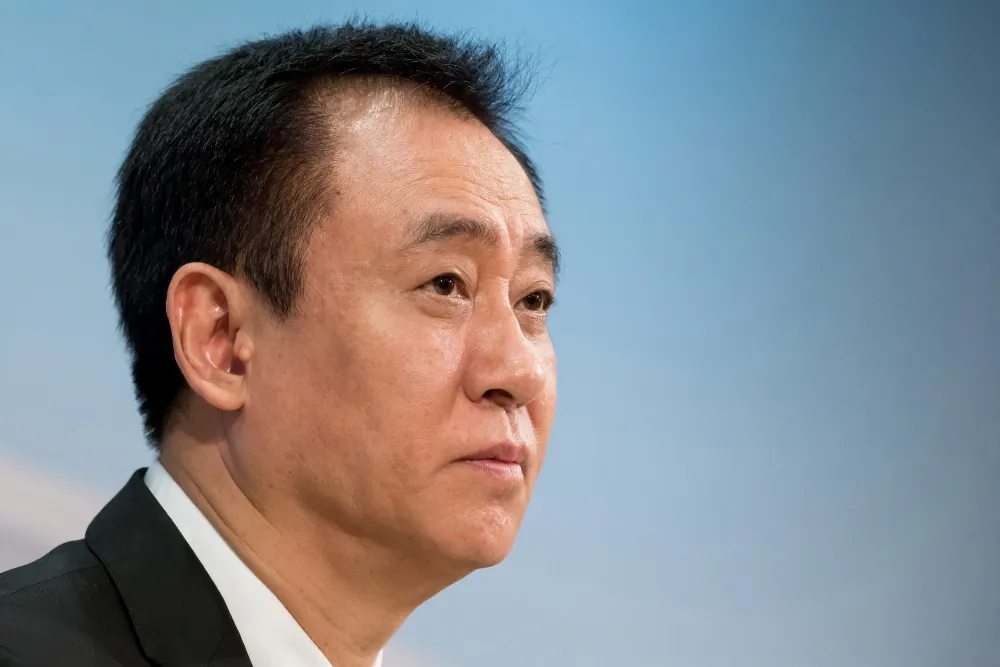
What the court decided. On 20 August 2026, a Shenzhen court sentenced Hui Ka Yan — founder of China Evergrande Group, once Asia's second-richest man — to life imprisonment, deprivation of political rights for life, and confiscation of all personal property. He had pleaded guilty in April. The court also imposed two corporate fines: ¥8.82 billion (US$1.31 billion) on China Evergrande Group and ¥7 billion (US$1.04 billion) on Hengda Real Estate, its main mainland development arm. Together, roughly $2.35 billion.
What he was convicted of. The judgment spans a range of offences accumulated across the boom years and the collapse:
- Embezzlement of corporate assets
- Corporate bribery
- Illegal absorption of public deposits
- Fundraising fraud
- Fraudulent issuance of securities
- Illegal disclosure of key information
That list matters because it is not a story about one bad quarter. Fraudulent securities issuance and illegal disclosure describe a company misrepresenting itself to investors over time; illegal absorption of public deposits describes money taken from the public outside the banking system.
This was not one man's trial. Hui's sons, Xu Tenghe and Xu Zhijian, were sentenced alongside him, as were dozens of others tied to the group, with terms running up to 18 years. Some reporting puts the total above fifty individuals with sentences from 22 months to 18 years; that fuller figure is less firmly attributed than the “dozens… up to 18 years” account, and is worth treating as indicative. Either way, the scale is the point. This was a systemic prosecution of a corporate apparatus, not the removal of a single tycoon.
What a fine actually is — and isn't. Here is where most coverage stops, and where the interesting mechanics begin. A criminal fine is a payment from the offender to the state. It is not compensation, and it does not flow to the people the company owes. Creditor recovery happens somewhere else entirely: in insolvency proceedings, against whatever assets can be found and sold.
So a fine and a recovery are two separate pipes. The question is whether there is anything in the estate to fill either.
The insolvency arithmetic. Evergrande collapsed with more than $300 billion in liabilities following its 2021 default. A Hong Kong court ordered the holding company into liquidation in January 2024; in August 2026 a Guangzhou court accepted a bankruptcy liquidation case against the mainland development unit that carried much of the debt. Within the court-supervised process, creditors have filed claims of roughly $45 billion.
Expected recovery is not a haircut. It is close to a wipeout. Industry analysts expect creditors to recover single-digit percentages of liabilities; an earlier Deloitte estimate put average recovery on the company's notes at 3.4% in a liquidation. Offshore bondholders are expected to receive a few cents on the dollar, and to wait years for it — in part because almost all the assets sit in mainland China, which creates real jurisdictional friction for administrators appointed in Hong Kong.
What China's own law says about the order. This is the part that reframes the fines, and it is written into the statute rather than inferred. Article 36 of the Criminal Law of the People's Republic of China provides that where a criminal act causes economic loss, the offender is sentenced to compensate that loss — and that where an offender owes both civil compensation and a fine, “if his property is not enough to pay the compensation and fine in full… he shall first pay civil compensation to the victim.”
Civil compensation ranks ahead of the fine. The Shenzhen court's own language points the same way: the defendants' illegal gains “shall be further recovered, and where recovery is insufficient, restitution shall be ordered.”
So what are the fines for?. Put the two facts together and the answer is fairly precise. In an estate where recovery is expected in the low single digits, there is no realistic surplus from which a ¥15.82 billion fine gets paid after compensation is satisfied. The fine is therefore unlikely to be collected in anything like full.
But — and this is the distinction worth holding onto — that is not the same as calling it symbolic, and it is not a design flaw. The subordination is deliberate and it is protective: the law is structured so that the state's claim does not compete with the people who lost money. A fine that ranks behind victims cannot crowd them out. What it can do is record culpability at corporate scale, in a number, in a judgment. That is a real function. It is simply not a financial one.
Where recovery is actually being pursued. The money, to the extent it is found at all, is being chased through other channels. Liquidators have sought $6 billion from Hui and his ex-wife, and are pursuing $8.4 billion from PwC, Evergrande's former auditor, which has separately faced fines totalling around $228 million. Hui's own sentence includes confiscation of all personal property. These are claims against people and firms with assets, rather than against a shell with none — which is why they, not the corporate fines, are where creditors' realistic hopes sit.
Why it matters. Evergrande is the reference case for how China assigns responsibility for a property collapse that is still working itself out. The verdict answers the accountability question comprehensively — dozens of individuals, the founder, the auditor, the corporate entities. It does not answer the recovery question, because that question was largely settled by the arithmetic in 2021. Anyone reading the sentencing as a step toward creditors being made whole is reading a criminal judgment as an insolvency outcome. They are different proceedings with different purposes, and in this case with very different prospects.
What happens next. and it is checkable. The Guangzhou liquidation of the mainland development unit is the process that will actually determine recovery, and its asset sales are reportable. The PwC claim is live and will either settle or be litigated. Liquidators' periodic reports disclose realisations. And the number to watch is not the fine — it is the recovery rate when the mainland estate begins distributing, against that 3.4% benchmark.
Sources (9)
- South China Morning Post: Saga of China Evergrande founder Hui Ka-yan ends with life sentence, 20 August 2026
- Bloomberg: China Sentences Evergrande's Hui to Life for 'Heinous' Crime, 20 August 2026
- NPR: Chinese court sentences founder of property developer Evergrande to life in prison
- CNN Business: Evergrande founder Hui Ka Yan sentenced to life in prison in China
- Fortune: China's onetime richest man has lost everything but creditors are still owed $300 billion, 21 August 2026
- Supreme People's Procuratorate: Criminal Law of the People's Republic of China — Article 36, on the priority of civil compensation over fines
- Bloomberg Law: Evergrande Creditors Owed $45 Billion Face More Complex Path
- Business Standard: Evergrande creditors to recover just fraction of debt after liquidation (Deloitte estimate)
- Washington Times: China moves to wrap up saga of troubled property giant Evergrande after founder gets life sentence
About the author
Muhammad ZahidFounding Editor, BriefLookout
Muhammad Zahid is the founding editor of BriefLookout, an independent publication focused on explaining what happened, what it means, why it matters, and what could happen next. He works across editorial strategy, research, and the systems behind BriefLookout to make complex developments easier to understand.
More from Muhammad Zahid →Related reading
Inside the retailer earnings season no one predicted
BriefLookout · 9 Aug 2026 · 5 min read
Why mid-size manufacturers are re-shoring twice as fast as large ones
BriefLookout · 3 Aug 2026 · 5 min read
Explainers · Explainer
What a special-purpose vehicle is, and why nobody is buying the AI chips any more.
Muhammad Zahid · 26 Aug 2026 · 5 min read