What Is a Data Center, Actually?
Every search, stream, and AI chat you've ever done was processed somewhere—usually inside a windowless building most people will never see. Here's what a data center actually is and how it works.
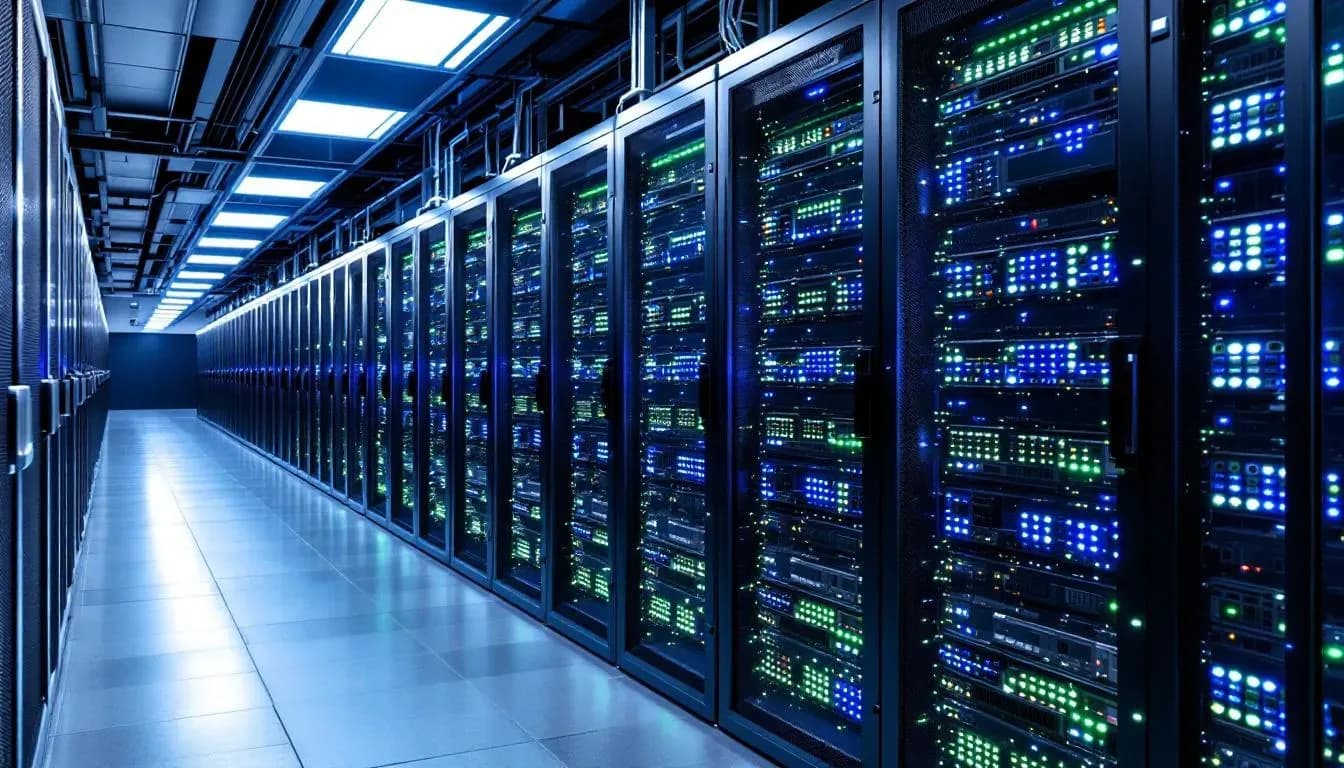
The Basic Idea—A data center is a large building full of computer servers that store and process data for the internet—email, websites, video streaming, cloud storage, and now, increasingly, the computing behind AI tools. Instead of your phone or laptop doing the heavy lifting, a data center does it remotely and sends the result back to you in milliseconds. When you save a photo "to the cloud," search Google, or ask an AI chatbot a question, you're really sending a request to a server sitting in one of these buildings.
What's Actually Inside One—Rows and rows of server racks—metal shelving units packed with computers stacked on top of each other—connected by miles of cabling. Unlike a personal computer, these servers run 24/7 without stopping, which generates enormous heat. That's why a data center isn't just computers: it's also an industrial-scale cooling operation, often using chilled water or air conditioning systems the size of a small factory, to keep the machines from overheating and shutting down.
Why They Need So Much Power—A single large modern data center can use as much electricity as a small city. That's partly because the servers themselves draw constant power, and partly because the cooling systems needed to offset all that heat use even more. This is also why data centers are usually built somewhere with cheap land, easy access to power infrastructure, and—for cooling—often near a reliable water source.
Some Numbers That Put It in Perspective—There are now more than 11,800 data centers worldwide, and the U.S. alone has nearly half of them. A single large hyperscale facility—the industry term for the biggest cloud and AI data centers—can demand upwards of 100 megawatts of power, roughly enough to run 400,000 electric vehicles at once. Globally, data centers used an estimated 415 terawatt-hours of electricity in 2024—about 1.5% of all electricity used on Earth—and that number is expected to roughly double by 2030. In Ireland, a country that became an early hub for tech company data centers thanks to its cool climate and tax incentives, data centers now account for more than 20% of the entire nation's electricity use.
Why They're Multiplying So Fast Right Now—For years, data center growth tracked fairly predictably with the rise of cloud computing and streaming. That changed with generative AI. Training and running large AI models—the kind behind chatbots, image generators, and AI search—requires vastly more computing power than a typical website or app, and that computing has to happen somewhere. AI-related processing already accounts for roughly a quarter of all data center electricity use as of 2026, and some forecasts expect AI workloads to eventually make up more than two-thirds of total data center demand by 2030. That's the engine behind the current building boom: every major AI company needs somewhere to physically run its models, and existing data center capacity simply wasn't built for computing at this scale.
A Few Genuinely Interesting Details—Cooling isn't a minor detail—it typically eats up 30–40% of a data center's total energy use, which is why some companies have experimented with unusual solutions, like sinking data centers underwater to use the ocean as a natural coolant. The "PUE" (Power Usage Effectiveness) score measures how efficient a data center is—a perfect score is 1.0, meaning zero energy is wasted on anything but computing. The average data center scores around 1.56; the most efficient hyperscale facilities get as low as 1.09. Google alone reportedly operates close to a million servers across its data centers worldwide.
Sources (5)
Related reading
Explainers · Explainer
What a special-purpose vehicle is, and why nobody is buying the AI chips any more.
Muhammad Zahid · 26 Aug 2026 · 5 min read
Explainers · Explainer
How model context protocols let AI agents use tools
BriefLookout · 20 Jul 2026 · 4 min read
Explainers · Explainer
What is quantitative tightening, actually?
BriefLookout · 15 Jul 2026 · 4 min read