Nepal's Deadliest Flood in Decades Started With a Glacier
A glacier collapse in the Himalayas on August 26, 2026, triggered a flood that has killed over 1,400 people and left thousands missing—and points to a much larger risk building across the region as its glaciers retreat.
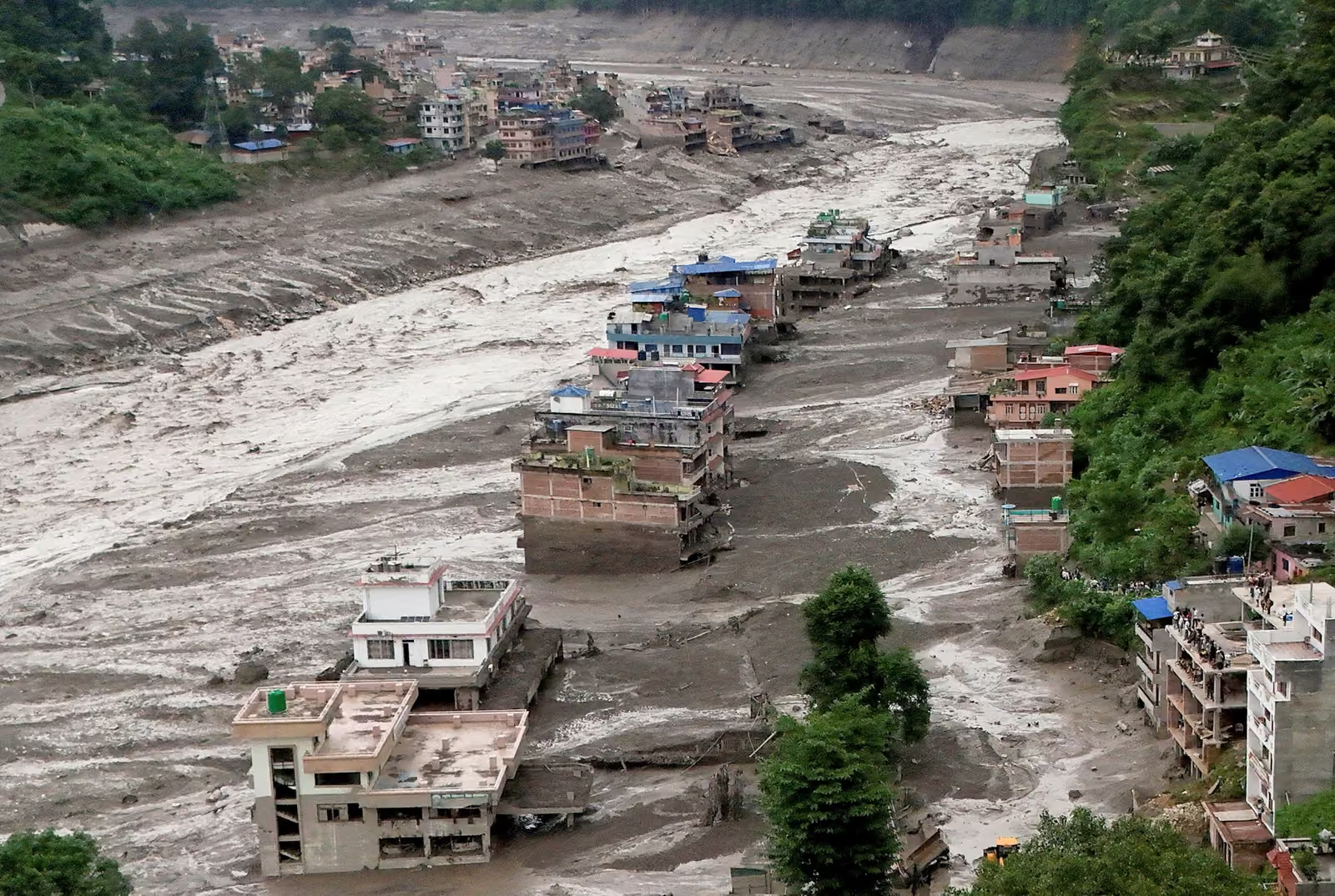
What Happened—On the morning of August 26, 2026, a mass of ice and rock broke away from Langtang Lirung, a glacier high in Nepal's Langtang National Park, and came down the mountain as a catastrophic debris flow. The collapse released energy equivalent to a magnitude-5.2 earthquake, and within minutes it had turned into a wall of water, mud, and rock racing down the Bhote Koshi and Trishuli rivers. It travelled nearly 100 kilometers downstream, tearing through the Nepali districts of Rasuwa, Nuwakot, Dhading, Gorkha, and Tanahun, and destroying the Gyirong Port, a major trade and pilgrimage crossing on the China-Nepal border.
The Damage—The scale of destruction has kept climbing for weeks. As of early September, more than 1,400 people were confirmed dead in Nepal, with thousands still missing; Tibet reported dozens more dead and hundreds missing on the Chinese side of the border. Roughly 84,000 people across six districts were affected.
The flood destroyed 32 bridges and nearly 25 miles of road, including the entire route connecting Nuwakot to the Rasuwagadhi border crossing, and knocked out 14 hydropower and solar projects with a combined capacity of 748 megawatts. Nepali officials estimate total economic damage at $4 to $7 billion.
Both Nepal and China have kept recovery efforts largely in the hands of their own teams, accepting outside search-and-rescue help mainly from India, Australia, and South Korea, while international donors have pledged more than $820 million toward the response.
Why This Happened—It's tempting to read this as a single freak event—and in one narrow sense, it was: experts from the International Centre for Integrated Mountain Development (ICIMOD) have said the immediate trigger was an ice-and-rock avalanche, not a glacial lake bursting through its banks, so this specific disaster can't yet be directly pinned on a warming climate. But that technical distinction sits inside a much larger, well-documented trend that climate scientists have been warning about for years.
The Bigger Picture—The Hindu Kush Himalaya region, the "Third Pole," source of water for nearly two billion people—is losing glacier mass at an accelerating rate: roughly 89% of the years since 2000 have shown a net loss, and by some estimates that loss has sped up 65% faster over the past decade than the decade before it. The region is warming at roughly twice the global average. As glaciers retreat, they leave behind lakes held back by loose rock, sediment, and ice—unstable dams that can fail suddenly in events called glacial lake outburst floods, or GLOFs.
ICIMOD currently tracks around 200 such lakes across the wider region as "potentially dangerous," including 47 inside Nepal alone, and warns that overall GLOF risk could eventually triple. Some of the most destructive recent floods have come from smaller lakes, not from the large, famous ones that get monitored most closely.
Warmer temperatures make this worse in two directions at once: they fill glacial lakes with more meltwater while destabilizing the frozen ground and hanging ice above them, making an avalanche or rockfall more likely to set one off. Scientists describe it as lakes growing bigger and less stable at the same time. The long-term trajectory is stark: even under the Paris Agreement's most ambitious 1.5°C target, the Hindu Kush Himalaya would likely still lose around 30% of its glacier volume by 2100; under higher-emissions scenarios, some estimates put losses across parts of the Himalayas as high as 80%.
What's Next—None of this guarantees any specific glacier collapses on any specific morning. But it explains why disaster researchers describe places like Rasuwa as facing something closer to a slow-motion emergency than a one-time accident—and why the response to this flood is already shifting attention toward expanding early-warning systems and glacial monitoring across a region where, right now, only a small fraction of glaciers are closely watched at all.
Sources (6)
- ICIMOD — "Kyirong-Rasuwa Flood 2026: Nepal-China Cryosphere Risk
- CARE — "Nepal flash floods 2026: CARE's emergency response"
- UNDP — "Nepal Floods 2026"
- Britannica — "Nepal floods of 2026
- Nepal News — "Around 200 lakes across the Himalaya could burst: why Nepal faces a slow-motion emergency"
- The News Minute — "Why is disaster risk increasing in the Himalayas?"
Related reading
Global power emissions went flat. America's went up 4.3% — and the reason isn't what most people assume
BriefLookout · 26 Aug 2026 · 4 min read
What Is a Data Center, Actually?
BriefLookout · 18 Sep 2026 · 3 min read
Explainers · Explainer
What a special-purpose vehicle is, and why nobody is buying the AI chips any more.
Muhammad Zahid · 26 Aug 2026 · 5 min read