The Fed held rates all year. Its own minutes now show real debate over raising them.
Minutes from the Fed's July meeting show officials split over a rate hike, as inflation holds well above target and Middle East tensions push oil prices higher — with the next decision due September 16.
What happened. Minutes from the Fed's July 28–29, 2026 meeting, released August 19, show the FOMC voted 9–3 to hold its benchmark rate at 3.5%–3.75%. Three officials — Hammack, Kashkari, and Logan — dissented, preferring a 25-basis-point increase, arguing "price pressures appeared broad based." The minutes go further than the vote count: "many participants assessed that policy tightening would likely be necessary if inflation did not decline" — meaning the three formal dissenters weren't the only ones leaning toward a hike, just the ones willing to vote for one at that meeting.
What it means. This is a real shift in direction. Core PCE inflation — the Fed's preferred gauge — was an estimated 3.3% for June, total PCE 3.7%; both well above the Fed's 2% target, and May's readings were higher still (4.1% total, 3.4% core). None of this is inflation cooling toward target — it's holding stubbornly above it, and the committee's own language now reflects that.
Why it's happening. The minutes tie part of the pressure directly to oil: "oil prices ended the period higher following the escalation of tensions in the Middle East," with the conflict also disrupting global energy and food supply chains more broadly. As of August 20, Brent crude — the international benchmark — was trading around $93 a barrel, with continued disruption to Strait of Hormuz shipping cited as a factor keeping prices elevated even as Gulf producers route crude through alternative paths. Worth being precise: oil hasn't reached $100 a barrel; the pressure is real but more moderate than that figure would suggest.
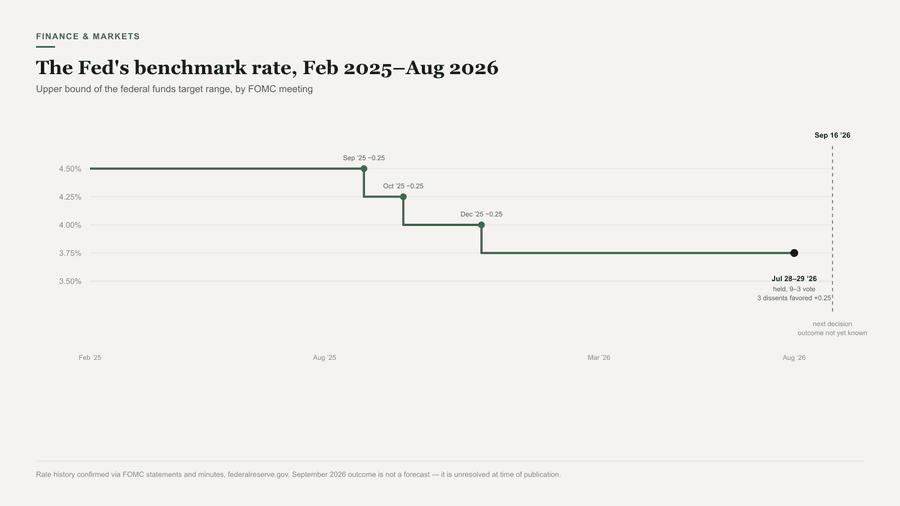
Why it matters. A hike raises borrowing costs across mortgages, auto loans, credit cards, and business financing. It would also cut against the widespread financial-press narrative earlier this year that centered on when, not whether, the Fed would eventually cut — a narrative the July minutes now complicate directly. Savers holding cash or short-term Treasuries would see better returns if rates rise further.
What's next. The Fed's next scheduled decision is September 16, 2026. Bank of America Global Research said in an August 7 note that a hike remains "firmly in play" — that's one firm's assessment, not a market-wide consensus, and worth treating as exactly that. What's confirmed directly from the minutes: the internal debate is real, inflation hadn't meaningfully cooled by the data available at the July meeting, and September is the meeting to watch for whether "many participants" leaning toward tightening becomes an actual majority vote.
Who's affected. Anyone with a variable-rate loan or shopping for a mortgage or auto loan in the coming months. More broadly, equity and bond markets face a real repricing question if September moves toward a hike rather than a hold.
Related reading
The biggest sanctions package ever aimed at Iran targets an oil trade that has already stopped.
Muhammad Zahid · 24 Aug 2026 · 5 min read
The Treasury tried to steady the bond market. The move lasted a day.
Muhammad Zahid · 24 Aug 2026 · 5 min read
Why the yield curve steepened twice in one week
BriefLookout · 11 Aug 2026 · Updated 12 Aug 2026 · 6 min read