NASA's next flagship telescope is launching nine months early. That's the strangest thing about it.
Roman was committed to fly by May 2027. It is scheduled for 30 August 2026, inside its cost cap. And it is not a better Hubble — it is a different kind of instrument, whose hardest problem may be the 20 petabytes it sends home.
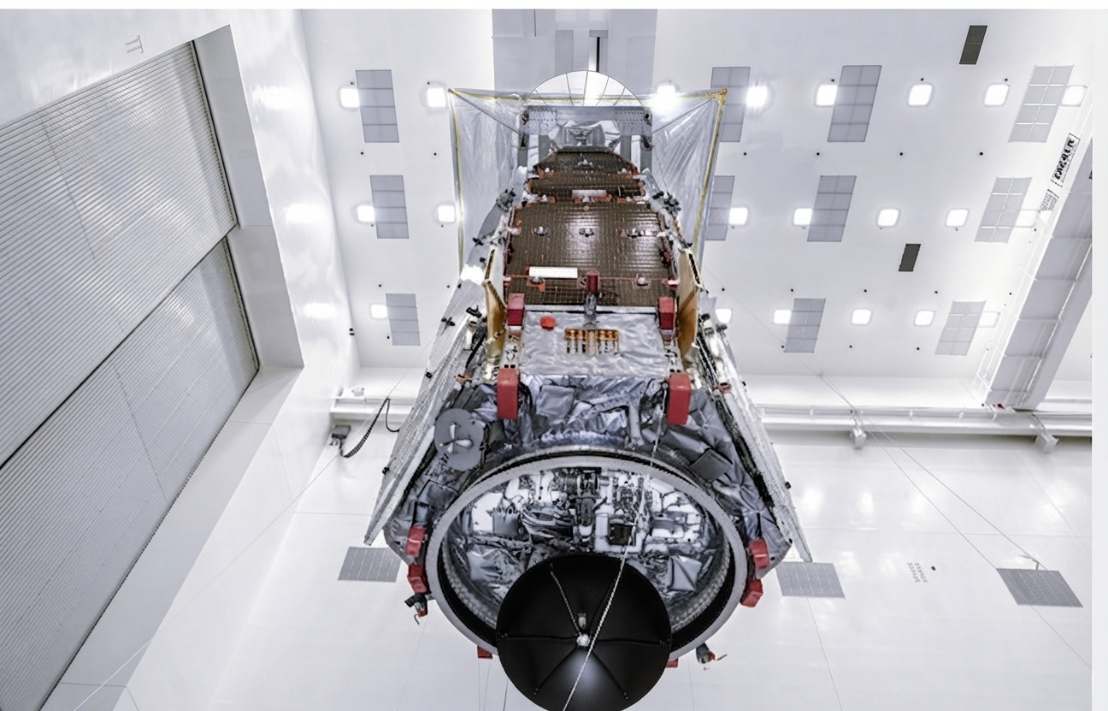
What happened. On Friday 21 August 2026, NASA and SpaceX completed the Flight Readiness Review for the Nancy Grace Roman Space Telescope, certifying it to begin final launch preparations. Launch is set for no earlier than 7:26 a.m. EDT on Sunday 30 August, aboard a Falcon Heavy from Launch Complex 39A at Kennedy Space Center.
The date is the story's first oddity. Roman's formal launch readiness commitment was May 2027. Flying at the end of August 2026 puts it roughly nine months early — and NASA attributes that to disciplined planning under a hard cost cap. For a class of mission whose public reputation was set by the James Webb Space Telescope's years of delay and cost growth, a flagship observatory arriving early and within budget is genuinely unusual.
Why Roman is not simply another Hubble or Webb. Hubble and Webb are pointing telescopes. You give them a target, they stare at it, and they return extraordinary depth on a very small patch of sky. That design answers questions of the form “what is that thing, in detail?”
Roman is a survey telescope. Its primary mirror is 2.4 metres — the same size as Hubble's. But its Wide Field Instrument, a 300-megapixel detector, sees a patch of sky at least 100 times larger in a single exposure. NASA's own framing: one Roman image holds the equivalent detail of a hundred Hubble pictures.
That is a difference in kind, not in quality. Roman will not out-resolve Webb on a single galaxy. It will do something Webb structurally cannot: cover enough sky, fast enough, to make rare things common.
What the wide field changes. Rarity becomes tractable. Phenomena that occur once per enormous volume of space — a particular kind of stellar explosion, a chance alignment that bends light, a planet passing in front of a distant star — are effectively unobtainable when you can only examine one small patch at a time. Widen the field a hundredfold and they arrive in bulk.
What Roman will measure. Principally three things. Light from a billion galaxies over the mission's lifetime, whose subtly distorted shapes trace how matter is distributed. More than 1,000 exoplanets, from a microlensing survey of the inner Milky Way. And large numbers of stellar explosions used as distance markers.
That exoplanet population matters because it is the part of the field current methods barely reach. Most known exoplanets orbit close and hot, because those are the ones easiest to detect. Microlensing finds the opposite kind — worlds far from their stars, and some drifting unbound between them. It is the census of the cold majority, the planets that resemble most of our own solar system.
Why the data problem matters. Roman is expected to amass roughly 20 petabytes — 20,000 terabytes — of observations over its five-year primary mission. Once operational it will return about 1.4 terabytes of compressed data per day, more than 500 terabytes a year. For scale: Hubble has delivered more than 400 terabytes across 35 years of operations. Roman will send back over 500 times more data per day than Hubble does.
That is not a storage inconvenience; it changes where the difficulty lives. A pointing telescope produces observations a research group can inspect. A survey at this volume produces a catalogue no human will ever read through. The science depends on automated pipelines that identify, classify and measure objects — and on those pipelines being trustworthy, because a systematic error in the software becomes a systematic error in the cosmology. All of it will be processed into the Mikulski Archive for Space Telescopes and made publicly available. For a mission whose results are statistical, the analysis chain is not support infrastructure. It is part of the instrument.
Why dark energy is central. The universe's expansion is accelerating, and the cause is unknown. The placeholder name for it is dark energy. The decisive question is whether it is constant — a fixed property of space — or whether its strength has changed over cosmic history. Those two possibilities imply very different futures and very different physics.
Distinguishing them requires measuring the expansion rate at many epochs with enough precision that a small drift would show up. That is a counting problem, over a billion galaxies and large samples of stellar explosions, which is precisely what Roman was built to be.
What happens next. Launch no earlier than 30 August, weather and readiness permitting. Then a cruise to the Sun–Earth L2 point about a million miles out — a Lissajous orbit it will share with Webb and ESA's Gaia — followed by instrument calibration, then a five-year prime mission, with a possible five-year extension. Each is a dated, checkable milestone. The first meaningful test is simply whether the 30 August window holds.
Sources (12)
- NASA: Teams Complete Flight Readiness Review for NASA's Roman Telescope, 21 Aug 2026
- NASA: Nancy Grace Roman Space Telescope mission page
- NASA: Introducing the Roman Space Telescope
- NASA: Why the Roman Space Telescope?
- NASA: Roman Mission Gears Up for a Torrent of Future Data
- STScI: Roman Space Telescope Science Platform Will Open New Frontiers in Space Science
- STScI: Roman mission page
- ESA: Roman factsheet
- NASA/Astrobiology: WFIRST/Roman — scheduled to launch by May 2027 (original commitment)
- SpaceNews: Roman Space Telescope on track for late August launch
- Forbes: NASA's Roman Space Telescope to Launch This Month — Nine Months Ahead of Schedule
- Space.com: The Roman Space Telescope, NASA's next great observatory, is ready to launch Aug. 30
About the author
Muhammad ZahidFounding Editor, BriefLookout
Muhammad Zahid is the founding editor of BriefLookout, an independent publication focused on explaining what happened, what it means, why it matters, and what could happen next. He works across editorial strategy, research, and the systems behind BriefLookout to make complex developments easier to understand.
More from Muhammad Zahid →Related reading
Your brain's immune cells were supposed to be sealed in for life. In humans, blood cells start joining them at middle age.
BriefLookout · 26 Aug 2026 · 4 min read
Physicists didn't recreate the Big Bang. They caught a nucleus giving away its shape.
Muhammad Zahid · 25 Aug 2026 · 5 min read
The first mRNA cancer shot just worked in a real trial. The companies didn’t say how well.
Muhammad Zahid · 24 Aug 2026 · 5 min read