Your brain's immune cells were supposed to be sealed in for life. In humans, blood cells start joining them at middle age.
A Stanford team traced shared mutations between blood and postmortem brain tissue — the same logic an ancestry test uses — and found circulating immune cells taking up residence in the aging human brain as functional microglia. Mice don't do it. The non-human primates tested didn't either. This is not a story about a leaky barrier.
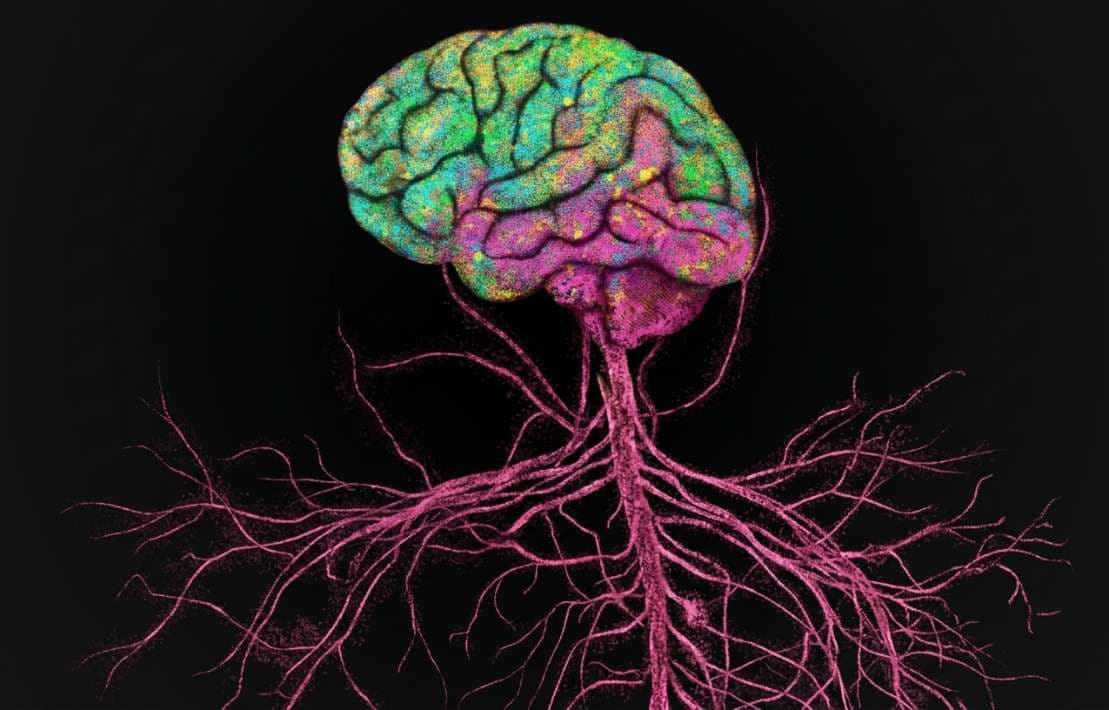
What was published. On 30 July 2026, Nature published work from Stanford led by postdoctoral scholar Julia Belk, with Siddhartha Jaiswal as senior author and Howard Chang among the team. The finding: immune cells from the bloodstream enter the human brain in substantial numbers beginning as early as middle age, where they become functional microglia — the brain's own resident immune cells.
Why does that overturn something? The textbook position, held for decades, was that microglia are established early in development and then maintain themselves in place for life, self-renewing behind the blood-brain barrier without meaningful resupply from the body. The brain's immune compartment was understood as effectively closed. This work says that in humans it is not closed, and that the opening is a normal feature of aging rather than a pathology.
How they showed it, and why the method matters. They did not watch cells cross. You cannot, in a living human brain. Instead the team used somatic mutation-based lineage tracing in matched blood and postmortem brain tissue from the same individuals.
The logic is genealogical. Every cell accumulates small random mutations as it divides, and cells descended from a common ancestor carry the same ones. If a microglia-like cell in brain tissue carries a mutation signature shared with blood cells from that same person, its ancestry is in the blood — it did not originate in the brain. It is, as one account put it, the same trick an ancestry test uses: relatedness inferred from shared markers rather than observed directly.
This matters for how strongly the result should be read. The evidence for blood origin is strong. The evidence for the journey is inferential — the cells are of blood lineage and they are in the brain, so they got there.
What this is not. It is not a finding that the blood-brain barrier "becomes leaky." That phrase implies a failing seal passing things indiscriminately, and it is the wrong picture. What is described is a specific population of immune cells entering and then integrating — adopting the identity and function of resident microglia. A leak does not produce functional replacements. This looks like recruitment, not failure.
It is also not, on this evidence, a finding about cognitive decline. The study characterises what happens in aging human brains. It does not demonstrate that this process causes, accelerates, or protects against any cognitive outcome.
The species result is the strangest part. The phenomenon was absent in mice and absent in the non-human primates tested alongside them. That is unusual and consequential. Mice are the workhorse of neuroimmunology, and a normal feature of human brain aging that mice simply do not exhibit is a gap in the model, not a detail. Any research programme that has been reasoning about microglial turnover from mouse data has been reasoning about a system that, in this respect, works differently.
Surveillance, repair, or damage? This is where fact ends and interpretation begins, and the honest answer is that the study establishes the phenomenon rather than its meaning. Cells arriving and becoming functional microglia is consistent with several readings: reinforcement of an aging population that can no longer self-renew adequately; a response to accumulating damage; or a process that is itself a driver of age-related inflammation. Stanford's own framing has leaned toward reinforcement. That is a reasonable reading of an integration phenomenon, but it is a reading.
Why it matters, carefully stated. If peripheral immune cells naturally enter the aging human brain, then a delivery route into the brain exists that does not have to be engineered — and getting therapies past the blood-brain barrier has been one of the hardest problems in neurology. Researchers have raised the prospect of engineering a patient's own peripheral immune cells to enter and perform specific functions, such as clearing amyloid-beta or tau aggregates. That is a prospect, not a result: nothing here demonstrates such a therapy works, or that clearing those aggregates changes disease course.
What happens next, and it is testable. Whether the finding replicates in independent postmortem cohorts, which is the first thing that should happen to any lineage-tracing result. Whether the arriving cells are functionally identical to native microglia or subtly different — the study says functional, and the next question is how functional. Whether the process differs between healthy aging and neurodegenerative disease, which would begin to separate reinforcement from damage. And whether any primate species shows it, because a truly human-specific mechanism would be remarkable and a merely rare one would be less so.
Sources (2)
Related reading
Physicists didn't recreate the Big Bang. They caught a nucleus giving away its shape.
Muhammad Zahid · 25 Aug 2026 · 5 min read
NASA's next flagship telescope is launching nine months early. That's the strangest thing about it.
Muhammad Zahid · 24 Aug 2026 · 4 min read
The first mRNA cancer shot just worked in a real trial. The companies didn’t say how well.
Muhammad Zahid · 24 Aug 2026 · 5 min read