Super El Niño: Why a Pacific Ocean Event Could Reach Your Wallet
A potentially record-strength El Niño is developing in the Pacific. Here's what it could mean for weather, food, water, trade and prices around the world.
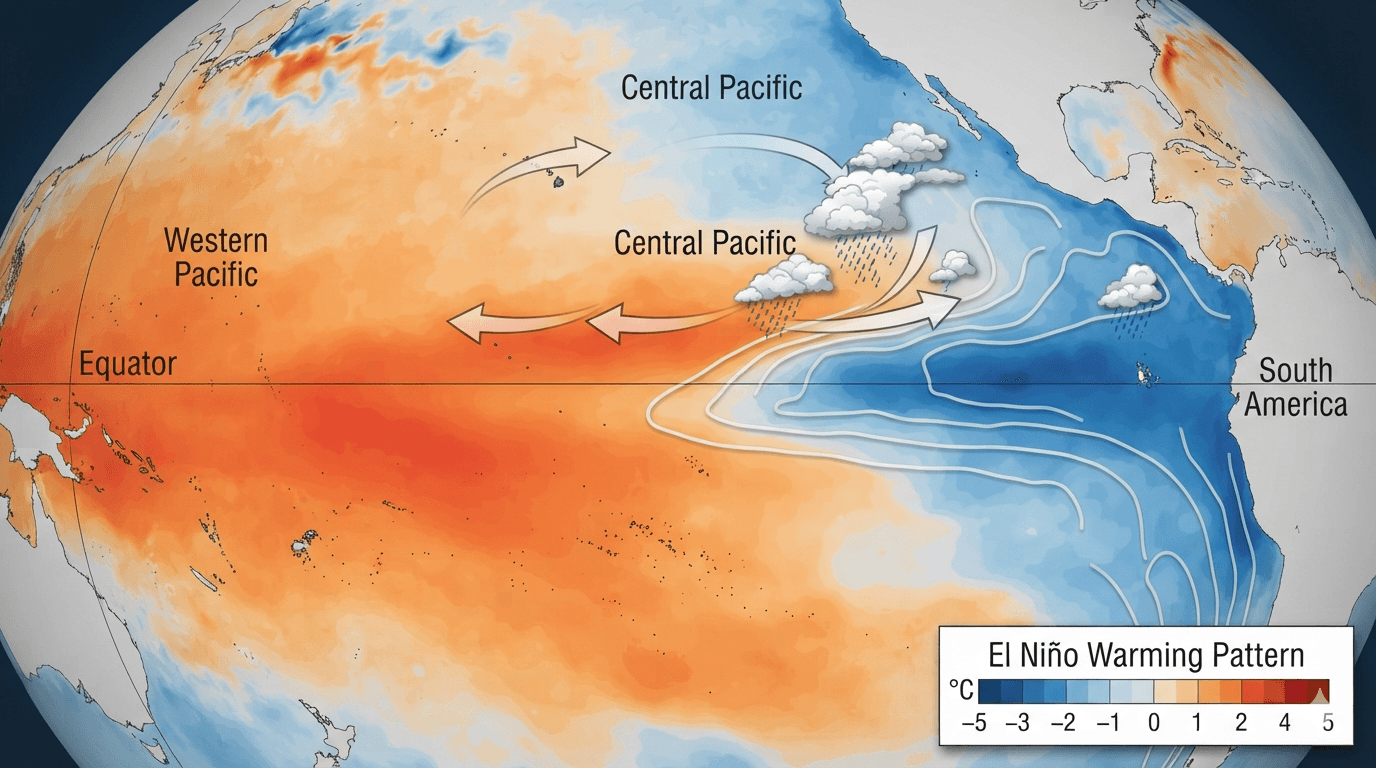
What happened?
A powerful El Niño is developing in the tropical Pacific, and forecasts suggest it could become one of the strongest events on record. The US Climate Prediction Center said in July that there was an 81% chance of a very strong El Niño during October–December 2026, potentially ranking among the largest events since records began in 1950. More recent forecasts have put the probability of a very strong event above 90%, while one analysis gives a 69% chance that the event could reach historic levels.
China's National Climate Centre has also warned that the developing event could become the strongest El Niño on record. That matters because El Niño does not stay in the Pacific. It changes atmospheric circulation and shifts weather patterns across large parts of the world. And when weather changes, the effects can move into food production, water supplies, energy systems and global trade.
What does it mean?
El Niño is the warm phase of a natural climate pattern known as the El Niño–Southern Oscillation, or ENSO. Normally, trade winds push warm surface water toward the western Pacific. During El Niño, those winds weaken and warmer water moves eastward. This changes the interaction between the ocean and atmosphere, affecting rainfall and temperature patterns far beyond the Pacific.
The current event developed unusually quickly. Carbon Brief's analysis of hundreds of model runs found that most forecasts point towards an El Niño that could exceed the previous record, although forecasts of this magnitude still carry uncertainty.
The important point is that a stronger El Niño changes the odds of certain weather extremes; it does not guarantee the same outcome everywhere. Some regions may become wetter. Others may become hotter and drier.
Why does it matter?
The biggest concern is what happens when those weather changes reach the real economy. In parts of South and Southeast Asia, Australia, and southern Africa, El Niño can increase the risk of heat and drought. In parts of South America, the opposite can happen, with heavier rainfall and flooding.
That creates a chain reaction:
Weather → Agriculture → Supply → Prices → Consumers
A drought can reduce crop yields. Flooding can damage farmland and infrastructure. Heat can increase water and electricity demand. Changes in rainfall can affect hydropower and river transport. And some of these effects are already visible. Severe weather linked to the developing El Niño recently shut the main Argentina–Chile border crossing in the Andes for 34 days, leaving hundreds of trucks stranded.
Food markets are another area to watch. Cocoa, coffee, and sugar are among the commodities exposed to changing rainfall and temperature patterns, particularly in major producing countries across Latin America, Africa, and Southeast Asia. The result does not have to be a global food crisis. Even relatively localized disruptions can tighten supplies and add volatility to commodity prices.
-900x502.png&w=3840&q=75)
What about climate change?
This is where the story needs some nuance.
El Niño is a natural climate phenomenon. Climate change is not.
Human-caused warming has raised the planet's baseline temperature, and an El Niño event adds a temporary natural warming influence on top of that background. That combination is one reason scientists expect the developing El Niño to push global temperatures higher. Carbon Brief estimates that the event could have its largest effect on global temperatures in 2027, when the warming influence of El Niño typically reaches its strongest point after the Pacific event peaks. But it would be misleading to say that climate change simply caused this El Niño or that it is definitely responsible for making this particular event stronger. The relationship between long-term warming and the strength of individual El Niño events remains an area of scientific uncertainty.
What happens next?
The key period will be the Northern Hemisphere autumn and winter of 2026–27, when the event is expected to reach its strongest phase.
The things to watch are straightforward:
- Pacific Ocean temperatures
- Rainfall and drought conditions
- Major agricultural crops
- Food and commodity prices
- Water availability
- Hydropower generation
- Shipping and transport disruptions
- Global temperatures
The strength of El Niño itself will tell only part of the story. What matters for people and businesses is how the resulting weather interacts with already-existing vulnerabilities in food, energy, water, and supply chains.
The takeaway
El Niño is not a storm moving toward one country. It is a shift in the Pacific that can change weather patterns across the world. If the current event develops into one of the strongest on record, its biggest consequences may not be felt in the ocean at all. They could appear in farms, reservoirs, power grids, shipping routes and commodity markets. The question isn't simply how warm the Pacific becomes. It's how far the consequences travel.
Sources (3)
- National Oceanic and Atmospheric Administration (NOAA), Climate Prediction Center. ENSO Diagnostic Discussion. August 2026.
- Reuters. Why 'super El Niño' leaves tropical commodities acutely exposed. August 18, 2026.
- Reuters. China forecasts strongest El Niño event as sea temperatures rise. August, 2026.
About the author
Muhammad ZahidFounding Editor, BriefLookout
Muhammad Zahid is the founding editor of BriefLookout, an independent publication focused on explaining what happened, what it means, why it matters, and what could happen next. He works across editorial strategy, research, and the systems behind BriefLookout to make complex developments easier to understand.
More from Muhammad Zahid →Related reading
Your brain's immune cells were supposed to be sealed in for life. In humans, blood cells start joining them at middle age.
BriefLookout · 26 Aug 2026 · 4 min read
Physicists didn't recreate the Big Bang. They caught a nucleus giving away its shape.
Muhammad Zahid · 25 Aug 2026 · 5 min read
NASA's next flagship telescope is launching nine months early. That's the strangest thing about it.
Muhammad Zahid · 24 Aug 2026 · 4 min read