A Robot Just Outran Usain Bolt but It Still Can't Hammer a Nail.
Beijing's second World Humanoid Robot Games produced record-breaking sprints, a 3.4-meter standing jump and just as clearly exposed how far humanoid robots still are from doing an ordinary day's work.
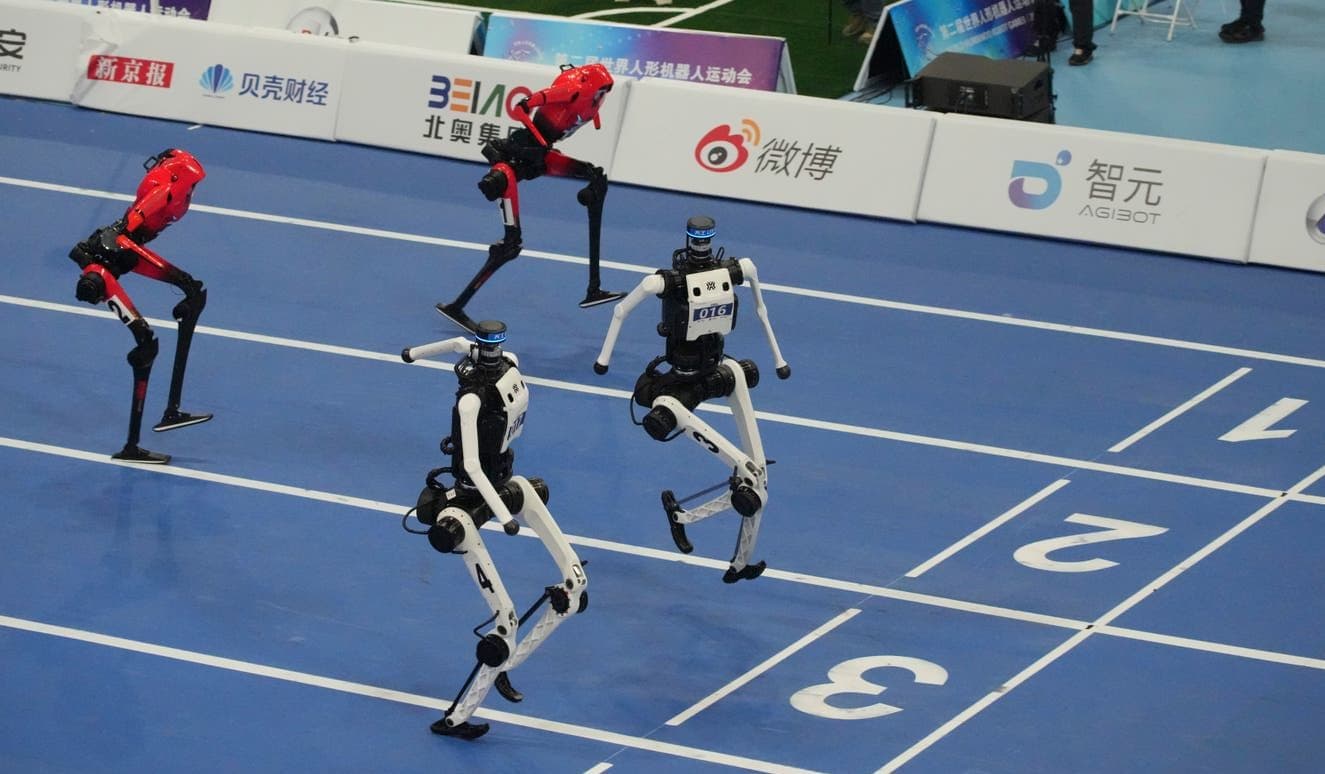
The Biggest Robot Event Ever Staged—Beijing hosted the second World Humanoid Robot Games from August 22 to 26, 2026, filling the National Speed Skating Oval with more than 600 teams, mostly from Chinese universities, research institutes, and robotics companies, and roughly 2,000 competing machines.
It was the largest public test of humanoid robotics ever staged, spanning more than 30 events across 11 disciplines: track and field, football, boxing, weightlifting, table tennis, and a newer category of "scenario-based" tasks built to mimic real jobs—shelving books, making beds, sorting medicine, and hammering nails.
Faster Than Bolt—A robot from X-Humanoid won 100-meter gold in 8.64 seconds, nearly a full second faster than Usain Bolt's 9.58-second human world record. What makes it a genuine story is the pace of change—the same robot ran that distance in 21.5 seconds just twelve months earlier, at the inaugural Games in 2025. Its sprint time more than halved in a single year.
Elsewhere on the track, an X-Humanoid robot jumped 3.4 meters vertically from a standing start, breaking a human record that had stood since 1993, and other robots—including Beijing's Tiangong platform—turned in record-breaking times across the 400 m and 1,500 m as well.
The Nail-Hammering Problem—The same week made clear how uneven that progress is. Robots collapsed mid-match in football, dropped weights in weightlifting, and locked up mid-motion in boxing. The nail-hammering event was the most humbling of all: even robots remotely operated by gloved team members struggled to drive a nail into a corkboard.
The gap has a simple explanation. Sprinting and jumping just follow a set path—the robot commits to the motion and lets its motors carry it through, with nothing to react to along the way. Hammering a nail or folding laundry is different: it takes constant small adjustments and a hand that can grip and apply force the way a human's does, and that's still a much harder problem to solve than running fast. Stanford computer scientist Karen Liu put it plainly to Nature: "Folding laundry is way harder than a backflip." In short, the tasks that look easiest to us are often the hardest for a machine.
From 500 Robots to 2,000 in a Year—The Games also showed how fast the event itself is scaling. The inaugural 2025 edition drew 280 teams, a little over 500 robots, 16 countries, and 26 events. At that closing ceremony, organizers launched a standing World Humanoid Robot Sports Federation and confirmed Beijing would host again—a promise that produced, a year later, roughly four times as many robots and a sprint time less than half as fast.
Why Beijing Is Staging This At All—None of this is happening in isolation. The Games ran the same week as the 2026 World Robot Conference, which opened on August 19 with more than 300 exhibiting companies and 150 new product debuts—making late August effectively China's annual showcase week for the whole humanoid robotics industry.
It also lands inside a larger industrial push: Beijing has set a national target of 100,000 deployed humanoid robots by 2027, and a separate government mandate requires state-owned enterprises to have 10,000 robots doing real commercial work by the end of 2026.
Seen against that backdrop, the stadium spectacle isn't just sport—it's a public proof-of-concept for an industry under real pressure to show it can build something more useful than a robot that runs fast and falls over.
Sources (5)
- Nature — "'Robot Olympics' reveal humanoids' rapid progress — and flaws"
- RobotsBeat — "Humanoid Robots Race, Fall, and Set Records at Beijing's World Humanoid Robot Games"
- explainx.ai — "World Humanoid Robot Games: History, 2026 Results, Future"
- Wikipedia — "World Humanoid Robot Games"
- Euronews — "WATCH: Robots sprint and play football at first world games in Beijing"
Related reading
Dyson has put a camera in a toothbrush. Its purpose is to make flossing automatic.
BriefLookout · 6 Sep 2026 · 1 min read
Tesla's Cybercab Is Finally on the Road — And the Hard Part Is Just Starting
BriefLookout · 5 Sep 2026 · 3 min read
Nvidia is reportedly raising AI server prices 15%. The interesting part is that it has to.
Muhammad Zahid · 25 Aug 2026 · 5 min read